On June 6, 2026, I lost my cat Adah. I'm still in shock, still crying on and off, and honestly still reaching for her out of habit. She was 8 years old and had been by my side for 7 of them. Writing this is hard, but I know it's something I need to do, because if you're searching for information about feline gastrointestinal lymphoma or trying to figure out what comes next after losing your cat, I want you to know you're not alone. I've been right where you are. Adah wasn't just a cat to me; she was like a daughter. She was the one who helped me survive losing my Maltese dog back in February 2019. I got her at the end of March that same year. She was actually my first cat ever. And somehow, without me even realizing it, she became the center of my world. I had no idea that choosing her would be one of the best decisions of my life or that letting her go would be one of the hardest. ⚡ Key Takeaways 🐱 Feline GI lymphoma is the most common c...
I recently woke up and realized I am 44 years old. It sounds funny to say, but for the longest time, I just drifted along thinking retirement was this far-off thing that old people do. But now, hitting my mid-40s with a husband, a duplex we are renting, and a whole zoo of pets to feed, the reality is setting in. I have about 20 years left to really aggressively save money if I want to stop working one day. I have a 401k through my job, and I contribute to it, but I started to get this nagging feeling that it wasn't enough.
Disclosure: This post contains referral links; as a SoFi customer, I earn a small amount from qualifying sign-ups. I appreciate your support.
That's why I finally opened an account with SoFi a couple of months ago. I went with their Robo Traditional IRA. I'll be honest with you: I chose the Robo option because I know absolutely nothing about investing. I didn't want to pick stocks and mess it up. I also realized after the fact that a Roth IRA might have been a better choice for me than a Traditional one, but it's too late to stress about that now. The important thing is that I started. If you're sitting there with just a 401k, or maybe nothing at all, you need to look at an IRA. It gives you control that your job's plan just doesn't offer.
⚡ Key Takeaways
💰 An IRA gives you tax benefits that a regular savings account can't offer.
📉 You can lower your taxable income right now with a Traditional IRA.
🤖 Automated investing tools make it easy if you don't know how to pick stocks.
🛑 A 401k usually has limited investment choices compared to an IRA.
⏳ Compound interest needs time to work, so starting in your 40s is crucial.
What exactly is an IRA anyway?
An IRA stands for Individual Retirement Account. It's not an investment itself. You don't "buy" an IRA. Instead, it's an account that holds your investments. Think of it as a special place where you keep stocks, bonds, and mutual funds. The government created these accounts to help people save for retirement by offering special tax breaks. If you just put your money in a regular bank account, you pay taxes on the interest you earn every year. In an IRA, you generally don't pay those taxes while the money grows.
This is a big deal because it allows your money to grow faster. I put 10% of my paycheck into a high-yield savings account (HYSA) with SoFi as well. That is great for my emergency fund or if I need to pay a sudden vet bill for Adah or Micah. But for the long term, a savings account doesn't pay enough interest to beat inflation. An IRA is where you put money you won't touch until you are at least 59 ½ years old. It's strictly for your future self.
The big mix-up: Traditional vs. Roth IRAs
This is where I got a little confused, and it's the most common question people have. There are two main types of IRAs: Traditional and Roth. The main difference is when you pay the taxes.
Traditional IRA
With a Traditional IRA, which is what I have, you often get a tax deduction when you put the money in. So, if I earn $50,000 and put $5,000 into my IRA, the IRS might only tax me as if I earned $45,000. That saves me money right now. However, when I retire and take the money out, I will have to pay income taxes on it. Since I'm renting right now and hoping to buy a house soon, saving money on taxes today helps me build up that down payment faster.
Roth IRA
A Roth IRA is the opposite. You pay taxes on your money today before you put it into the account. But the huge benefit is that when you retire, you take the money out tax-free. You don't pay a single cent to the IRS on all that growth. Many experts say this is better if you think taxes will be higher in the future. I had a moment of regret thinking I should have done this, but my husband reminded me that saving something is better than saving nothing.
Why your 401k isn't enough
You might be thinking, "I already have a 401k at work, why do I need this?" I thought the same thing for years. A 401k is fantastic, especially if your company matches your contribution. That is literally free money, and you should always take it. But a 401k has limits.
The biggest issue is the lack of choice. In my 401k, I have maybe 10 or 15 funds to pick from. They're fine, but they aren't exciting, and some have high fees that eat into my profits. With my IRA, I could theoretically pick from thousands of stocks or funds. Since I use the Robo advisor, SoFi picks them for me, but the underlying investments are often cheaper and more diverse than what my job offers.
Also, what happens if you lose your job? Your 401k is tied to your employer. You can move it, but it's a hassle. An IRA is yours. It doesn't matter where you work or if you take a break from working. It stays with you. For me, knowing I have an account that is 100% under my control feels much safer.
The magic of compound interest
This is the scientific reason you need to start now. Compound interest is when your interest earns interest. It sounds simple, but the math is crazy.
Let's say you invest $100 and earn 10% in a year. Now you have $110. The next year, you earn 10% on $110, not just the original $100. So you get $11, bringing you to $121. Over 20 or 30 years, this snowball effect is massive.
Since I am 44, I don't have 40 years for this to happen, but I do have 20. If I max out my contribution every year, that money will double and triple on its own. If I just left it in my regular savings account, it would barely keep up with the cost of lettuce for my guinea pig and rabbits. And let me tell you, Sugar, Lucy, and Ricky eats a lot of lettuce.
Starting late? It's okay
I used to beat myself up about not starting an IRA in my 20s. I would see articles about people retiring at 35 and feel sick. But looking backward doesn't help. The government actually knows people start late, so they have "catch-up contributions."
Right now, the limit you can put into an IRA is around $7,000 a year. But once you turn 50, you can add an extra $1,000 on top of that. I am already planning for that. In six years, when I hit 50, I plan to throw every extra dollar I have into that account. It's my way of making up for lost time.
Taking control with automated investing
One of the reasons I waited so long was fear. I didn't know what an ETF was. I didn't know the difference between a stock and a bond. It felt like gambling.
That's why I love the new automated options available today. When I signed up for the SoFi Robo Traditional IRA, they asked me a few questions. They asked my age (44), when I want to retire (65-ish), and how much risk I can handle. I told them I'm moderate (I want growth, but I don't want to lose everything if the market crashes).
They built a portfolio for me instantly. Now, every time my paycheck hits, money automatically goes into that account, and the computer buys the funds for me. I don't have to log in and trade. I don't have to watch the news. I just let it happen. It's perfect for someone like me who wants to be responsible but doesn't want to make investing a second job. I have enough work taking care of my husband, my five pets, and five community cats!
Tax breaks are a huge deal
We talked about this briefly, but let's look at the numbers. If I contribute the full $7,000 to my Traditional IRA this year, that's $7,000 that the IRS doesn't tax me on right now. If I'm in the 22% tax bracket, that saves me over $1,500 in taxes this year.
That's $1,500 I can use for other things. I can put it into my high-yield savings for the house down payment. I can use it to pay off a credit card. Or, realistically, I can use it to buy bulk cat food for the neighborhood cats I feed. Noro, my neighbor's cat, is practically living on my porch these days, and he has a big appetite. The point is, the government is basically paying you to save for your own future. It's one of the few "free lunches" in the tax code.
Income limits and rules
You do need to be careful about income limits. For a Traditional IRA, anyone with earned income can contribute. But, if you have a retirement plan at work (like my 401k), there are income limits for deducting that contribution on your taxes. If you make too much money, you might not get the tax break.
For a Roth IRA, there are strict income limits on who can open one. If you make a lot of money, you aren't allowed to contribute directly to a Roth. Since my husband and I work pretty standard jobs, we don't hit those high limits, so we have options. It's worth checking the IRS website or asking a tax pro to see where you fall.
Why I'm doing this now
We've been married for just over 20 years. We celebrated our 20th anniversary in November this year. For a long time, we just focused on paying rent and getting by. But renting this duplex has made me realize I want something of my own. I want a yard where I can build a safe outdoor run for the rabbits and guinea pig. I want a place where I don't have to ask a landlord if I can paint the walls.
My IRA is part of that big picture. By taking care of my retirement savings now, I feel less stressed about spending money on a mortgage later. I’ve also started using credit monitoring to make sure my score is ready for that loan application, which makes the whole dream feel much closer. I know that "Future Me" is going to be okay, so "Current Me" can focus on getting that house. It's about peace of mind.
You can start small
You don't need $7,000 to start. I started with just $50. The important thing is just opening the account. Once it is open, it is easy to add $20 here or $50 there. It adds up so fast.
If you're like me and have put this off, please don't wait another day. You don't need to be a financial genius. You don't need to be rich. You just need to care about your future. Go online, find a brokerage (SoFi, Fidelity, Vanguard; they're all good), and open an account. You'll be happy you did.
Getting your partner on board
It's also important to talk to your spouse about this. My husband and I keep our finances pretty transparent. He knows I opened this account, and we're looking into opening one for him too. Since we file our taxes jointly, we have to look at our total household income to see what our contribution limits are.
If your spouse doesn't work, they can actually still have an IRA. It's called a Spousal IRA. The working partner contributes on behalf of the non-working partner. This is a great way to double your family's tax savings and retirement funds. We don't need this since we both work, but it's a great option for many families.
Diversification protects you
Another buzzword you hear is "diversification." It just means not putting all your eggs in one basket. My 401k is mostly invested in big US companies. My IRA gives me the chance to invest in other things, like international companies or real estate funds.
If the US economy has a bad year, maybe my international funds will do well. By spreading my money out across my 401k, my IRA, and my savings account, I'm building a safety net. I learned this lesson watching the neighborhood cats. They don't just rely on one house for food; they visit four or five. If I'm out of town, Noro knows he can get food three doors down. That is diversification.
Protecting against inflation
Inflation is the silent killer of savings. We've all seen how much grocery prices have gone up lately. A carton of eggs costs way more than it did two years ago. If your money is sitting in a checking account earning 0.01%, it's losing value every single day because things are getting more expensive.
The stock market, over the long run, has historically gone up about 7% to 10% a year. That beats inflation. By investing in an IRA, you're ensuring that your money will still be able to buy bread (or eggs) in 2045.
Building Financial Security for the Future
I know it feels scary to lock money away where you can't touch it. But that restriction is actually a good thing. If that money was in my checking account, I might spend it on something I don't need (okay, yes, I definitely would). Because it's in my IRA, and I know I would get a penalty if I took it out, I leave it alone. It forces me to be disciplined.
We all want to retire with dignity. We want to be able to afford good healthcare and a comfortable home. Relying just on Social Security or a small 401k might not be enough. Adding an IRA to your financial plan is the best way to close that gap.
I hope my story helps you feel a little better about where you are. If I can do this at 44 with no experience, you can too. It's not about being perfect; it is about making progress.
FAQs
What is the maximum I can contribute to an IRA in 2025?
For the 2024 and 2025 tax years, the contribution limit is $7,000 if you are under age 50. If you are age 50 or older, you get a "catch-up" contribution allowance, bringing your total limit to $8,000. You must have earned income (like wages from a job) to contribute, and you cannot contribute more than you earned in that year.
Can I lose money in an IRA?
Yes, because an IRA is invested in the stock market (stocks, bonds, ETFs), the value goes up and down. However, over long periods (like 10 or 20 years), the market has historically gone up. By using a Robo advisor or a diversified fund, you spread out your risk so that one bad company doesn't ruin your savings.
Can I withdraw money from my IRA before I retire?
Generally, if you take money out of a Traditional IRA before age 59 ½, you'll pay income tax on it plus a 10% penalty. There are some exceptions, like for buying your first home (up to $10,000) or certain medical expenses. Roth IRA contributions (but not the earnings) can usually be withdrawn penalty-free at any time, but it is best to leave the money alone to grow.
On June 6, 2026, I lost my cat Adah. I'm still in shock, still crying on and off, and honestly still reaching for her out of habit. She was 8 years old and had been by my side for 7 of them. Writing this is hard, but I know it's something I need to do, because if you're searching for information about feline gastrointestinal lymphoma or trying to figure out what comes next after losing your cat, I want you to know you're not alone. I've been right where you are. Adah wasn't just a cat to me; she was like a daughter. She was the one who helped me survive losing my Maltese dog back in February 2019. I got her at the end of March that same year. She was actually my first cat ever. And somehow, without me even realizing it, she became the center of my world. I had no idea that choosing her would be one of the best decisions of my life or that letting her go would be one of the hardest. ⚡ Key Takeaways 🐱 Feline GI lymphoma is the most common c...
I've always been fascinated by near-death experience stories. There's something about hearing that someone died, saw something on the other side, and came back to talk about it that I just can't look away from. Are they really seeing Heaven? What does it look like? What does it feel like to be in the presence of God? When I was offered a free copy of 18 Days in Heaven by Gabe Poirot for review, I said yes immediately. Stories like this always pull me in. Little did I know that by the time I sat down to read it, I'd be walking through some grief of my own. I lost my sweet girl Adah to feline GI lymphoma a few weeks after I said yes to the review, and reading a book about someone who visited Heaven and came back hit differently than I expected. Disclosure: I received this item free in exchange for my honest review. All opinions are 100% my own. ⚡ Key Takeaways ✝️ Gabe Poirot was 20 years old when an electric skateboard accident left him flatlined ...
It's been almost a month since I posted anything here, and honestly, that's not like me. So I wanted to come back and just talk. Not a polished post about a topic, just an actual update on where things stand, because a lot has happened since I went quiet. Losing Adah If you've been following along, you already know I lost Adah on June 6th to GI lymphoma, something that got missed early on before we knew what we were actually dealing with. I wrote the full story here if you want the whole thing, so I won't retell it all again. But I'll say this. It still hurts just as much as it did that first week. Some days, it feels like a bad dream I haven't woken up from yet, like she's just going to come around the corner. I got a small memorial for her that I've got set up now, a little wooden heart that says "No longer by my side, but forever in my heart," hanging above a little glass jar with her collar tucked inside, right next to her picture. ...
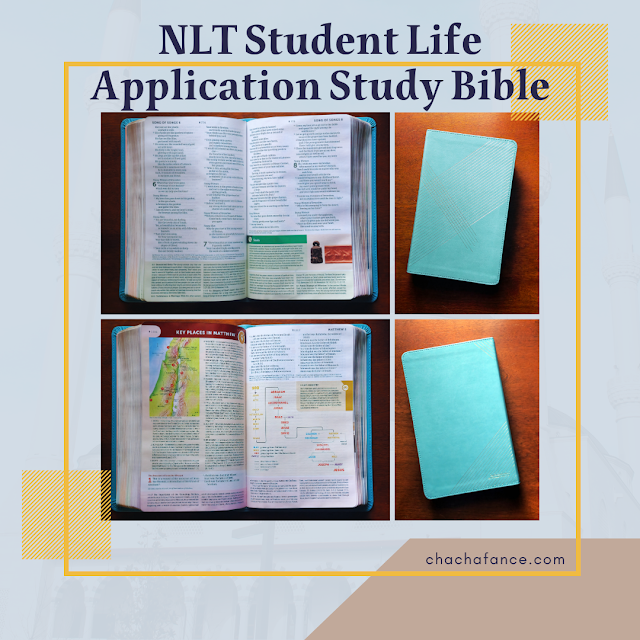
There's a new player on the biblical block: the NLT Student Life Application Study Bible, Filament-Enabled Edition . It's pretty awesome because it combines both beautiful artwork and intelligent insights. Trust me, it's a game changer when it comes to how easy it is to understand and how visually appealing it is. Let's take a deeper dive at the Bible you'll definitely want to add to your Bible Study arsenal! Unveiling a Unique Bible Like No Other This Bible is like no other! It's a powerful combination of rigorous scholarship, breathtaking design, and an unmatched dedication to making Scripture applicable to your everyday life. With the New Living Translation (NLT) as its foundation, the Student Life Application Study Bible takes your understanding of the Bible to a whole new level. It's packed with over 27,000 notes that you can find right on the page or access through the amazing Filament Bible app ( Android , iOS ). This app helps you dive deeper into y...



Comments
Post a Comment